
India - Pushkar Camel Fair Singles Vacation Daily Itinerary
RAJASTHAN, the land of kings is India at its exotic and colorful best. Our India singles vacation offers the traveler a potpourri of visual, culinary, spiritual, and cultural experiences while making friends and memories for life. Join Best Single Travel as we explore India, a land of fairs, forts, and palaces of breathtaking charm that add to its grandeur and mysticism.
Arrive in the capital of India, New Delhi and after clearing immigration and customs you will be met and transferred to the hotel. Note: normal check-in time is 2.00 pm.
Delhi is the capital of India. Its history goes back to 3000 years. Various rulers built eight successive cities in and around present-day Delhi resulting in its many monuments, of which Delhi is justly proud.
The rest of the day is free for independent activities & Overnight at the Hotel.
In the morning, visit the highlights of New and Old Delhi with a guide. Designed in 1911 by the British, New Delhi is one of the greenest capitals in the world. See the impressive Qutab Minar, a 234-foot-high red sandstone minaret. The buildings in this complex date from the onset of Muslim rule in India.
Drive past the government buildings and the Rashtrapati Bhawan (Presidential Palace) along the broad and majestic Rajpath before continuing to Old Delhi.
Then drive by the Red Fort, a symbol of Mughal power. Take a rickshaw ride around Chandni Chowk (an old shopping street) to visit the Jama Masjid Mosque area, the principal mosque of Old Delhi in India.
Commissioned by the Mughal Emperor Shah Jahan, builder of the Taj Mahal, and completed in the year 1656 AD, it is the largest and best-known mosque in India.
Also visit Raj Ghat, a memorial of the great Mahatma Gandhi, and time permitting the Bhai House of Worship a temple shaped in the form of a Lotus flower. Dinner & Overnight at the Hotel.
In the morning we travel south 3 1/2 hours to Agra along the Yamuna Expressway. The earliest reference to Agra is in the epic The Mahabharat. Ptolemy, Alexander the Great's geographer, also called it Agra.
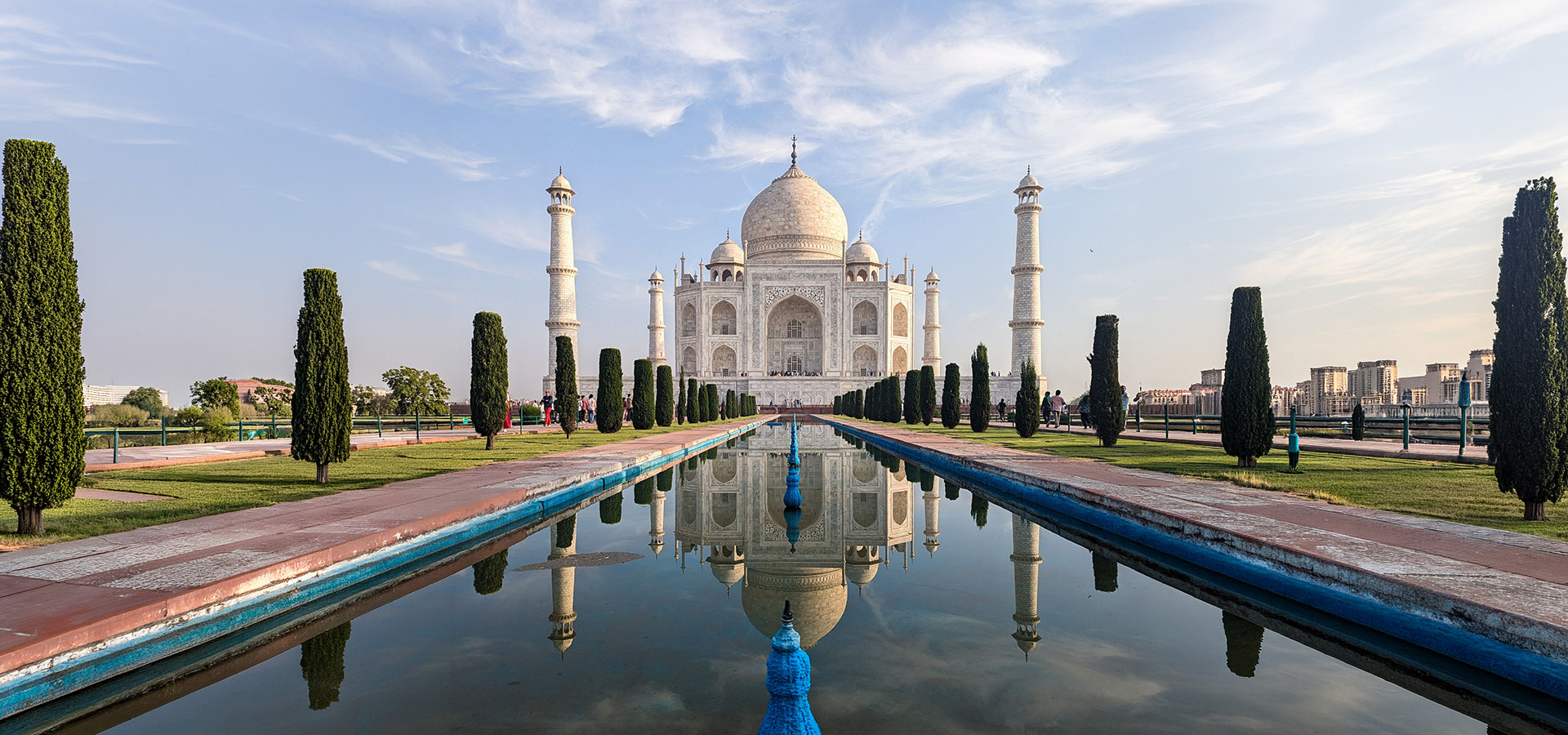
It was, however, in the medieval period that Agra earned prominence as a capital city under the Mughals. Its many wonderful monuments include the Taj Mahal, the greatest of them all. In the Afternoon visit the Taj Mahal with a guide.
The Taj Mahal is simply beautiful—not just in design and technique but also in desire and intent. It was built as a monument to love, a manifestation of life's most powerful emotion.
When his wife died unexpectedly, Emperor Shahjahan vowed to honor her with a memorial of unmatched beauty. He commissioned the world's best craftsmen and 20,000 workers to build this beautiful structure.
The result is a delicately carved, white marble jewel that seems to float on a sea of red limestone. The Taj Mahal is generally considered the finest example of Mughal architecture, a style that combines elements of Persian, Turkish, Indian, and Islamic architectural styles. In 1983, the Taj became a UNESCO World Heritage Site.
Also, visit the Agra fort. Near the gardens of the Taj Mahal stands the important 16th-century Mughal monument known as the Red Fort of Agra.
This powerful fortress of red sandstone encompasses, within its 2.5-km walls, the imperial city of the Mughal rulers, which comprises many fairy-tale palaces (Jehangir Mahal and Khas Mahal), halls of public and private audience (Diwan-i-Khas and Diwan-i-Aam), and two lovely mosques.
Early in the morning we travel west about 1 1/2 hours to Fatehpur Sikri, the once-fabled Mogul capital that has taken on a sleeping beauty quality, lying quietly but wonderfully preserved.
The Great Mughal Emperor Akbar built Fathepur Sikri (the City of Victory) during the second half of the 16th century as the capital of the Mughal Empire. A large number of masons and stone carvers worked hard on an area that was over two miles long and a mile wide.
Using the locally available red sand stone, they created a complex of monuments and temples, all in a uniform architectural style, including one of the largest mosques in India, the Jama Masjid.
Some fifteen years after the work was completed, it was realized that there was a lack of adequate water supply. The pristine complex was abandoned, and the capital shifted back to Agra.
Continue to Rantanbhor, about 3 ½ hours south-west, arriving for lunch at the hotel. Ranthanbhor encompasses nearly 152 square miles of dry deciduous forest in southwestern Rajasthan, and in the heart of this forest, the Aravali and Vindhya ranges meet.
The park derives its name from the fort of Ranthanbhor, which sits on a rocky outcrop in the forest. The landscape is dotted with ancient Banyan trees, Dhok and Pipal trees, clusters of mango trees, and crisscrossed with evergreen belts.
The terrain is made up of massive rock formations, steep scarps, perennial lakes and streams, and forest that suddenly opens up into large areas of savannah. For a relatively small area, the park has a rich diversity of fauna and flora.
The species list includes 300 trees, 50 aquatic plants, 272 birds, 12 reptiles (including the marsh crocodile), amphibians, and 30 mammals. Other than the tiger, for which the park is most famous, other predators found are leopards, striped hyenas, jackals, caracals, and jungle cats.
Also seen are sloth bear, sambar deer, chital (spotted) deer, nilgai (blue bull) antelope, wild boar, chinkara (Indian) gazelle, Indian hare, mongoose, common langur, palm civet, palm squirrel, porcupine, and monitor lizard.
In the afternoon, take a safari to the park to see wildlife in its natural habitat and to “hunt“ for the elusive tiger.
Early in the morning, at sunrise, we take a Jeep Safari to the Park to see wildlife in its natural habitat.
After breakfast continue about 2.5 Hrs South West to Bundi, a tiny picturesque and unexplored city rich in history surrounded by the Aravalli hills on three sides, it is circumscribed by a massive wall with four gateways and encloses medieval forts, palaces, havelis, temples with beautiful tone idols and chattris with carved pillars.
Visit The Taragarh Fort, or "Star Fort," the most impressive of the city's structures. It was constructed in AD 1354 upon the top of steep hillside overlooking the city.
The fort contains three tanks that never dry up. The technique used to build them has long been lost, but the tanks survive as a testament to the advanced construction and engineering methods of medieval India.
Lunch in Bundi. Parsoli for Dinner and Overnight.
After breakfast, we will visit the 7th century city of Chittorgarh, also called Chittaur, which evokes memories of great heroism and sacrifice by Rajput men and women in the intermittent battles that they had to fight against Muslim invaders.
Allaudin Khilji who coveted Queen Padmini of Chittaur, invaded the city in 1303 A.D. Queen Padmini and the women of the court sacrificed themselves in a pyre of fire rather than submit to anybody.
This supreme sacrifice has been called 'Jauhar' and epitomizes the fiery spirit of the Rajputs of the day. The honey-colored Fort is built on a hilltop and within are the remains of many temples and monuments.
The 15th-century, 9-story Vijay Stambh (Tower of Victory) is built from red sandstone and white marble.
We will continue to travel west for about 2½ hours to Udaipur. Also known as the Venice of the East, Udaipur is an enchanting city.
From the lakes in the midst of the sandy terrain to the green forested hills where wildlife still abounds, the surprises are endless.
Late afternoon, take a short boat ride and proceed to the old city for a walk around the bazaars, shops and havelis (mansions) before arriving at Bagore Haveli for a performance of local dances and music.
In the morning, we will visit the vast and exquisite City Palace of the Maharana, in which amber, jade, and colored glass give the palace a sparkling yet ethereal quality.
The City Palace was built concurrently with the establishment of Udaipur city by Maharana Udai Singh II and his successor Maharanas over a period of the next 400 years. The Maharanas lived and administered their kingdom from this palace, thereby making the palace complex an important historic landmark.
Also, we will visit Sahelion-ki-Bari, the garden of the maids of honor, and continue to the Crystal Gallery and the Vintage and Classic Car Museum, which have nearly two dozen of the Maharana's personal collections of exclusive cars.
The rest of the day is free for independent activities and overnight at the hotel.
After breakfast travel about 2 hours north to Ranakpur to visit the Jain temple complex.
Note: The Temple is open to visitors 12.00 noon to 4.00 pm and visitors are requested not to wear shorts or any dark colour clothing, blue, black etc.
The Jain temple of Ranakpur, unique in its architectural elegance, is a 15th-century temple built in white marble with exquisitely intricate carvings. The entire complex, built on over 40,000 sq ft, comprises 29 halls, 5 spires, 20 domes, and 420 pillars.
The temple is enclosed on all four sides by a row of 86 chapels. All the architectural elements are covered with carvings that are so delicate that they look like lacework. It is amazing to find that among hundreds of pillars, no two are alike.
Continue to Kumbalgarh, one hour north-east, and after lunch at the hotel, visit the Kumbalgarh Fort, a fascinating place built in the 15th century by Maharana Kumbha on top of the Aravalli range at 1100 meters.
The Fort contains palaces and is encircled by enormous walls reminiscing of the Great Wall of China. Dinner and overnight at the hotel Maharani Bagh Orchard in Ranakpur.
After breakfast travel north about 2 and a half hours to Jodhpur, also known as the BLUE CITY stands at the edge of Thar Desert and blends modern and traditional elements.
The city is totally dominated by a massive fort sprawled across a 125-meter-high hill known as Meherangarh Fort, founded by Rao Jodha in 15th century.
Visit the Meherangarh Fort, which was considered impregnable due to the rocky base on which it's built. Within are the royal palaces, exhibitions of priceless jewels and a striking collection of arms.
The Ramparts offer a magnificent view of this Blue City.
In the Morning travel outside the city to the Bishnoi Villages to experience firsthand the authentic rural life of India, including its local cultures and traditions.
The Bishnoi’s are steeped in history and this 450-year old tribe has a distinctive way of life. They are environmentalists in the fundamental sense, preserving and living with nature by nature.
Witness how the villagers use their meager resources to make daily-use items. See the pot maker, shoemaker in action. Visit a few homes and meet the villagers to learn about their farming practices and how they keep their animals.
Have lunch, return to the city, and in the early evening, visit Sardar Bazaar and Clock Tower markets. There, you can see the vegetable, spice, Indian sweets, and textile and silver markets and enjoy a Tonga (Horse carriage) ride.
After breakfast, we will travel east for about 4 hours to the holy city of Pushkar.
One of Hinduism’s holy cities associated with Lord Brahma, Pushkar, is in the center-east part of Rajasthan, on the western side of the Aravalli mountains, and is centuries old, having been mentioned in ancient texts like the Ramanaya, Mahabharata and Puranas, as well as in many other texts dated to the 1st millennium.
Pushkar comes alive during the month of Kartik of the Hindu calendar (corresponding to October or November), when the full moon night is celebrated in honor of the day when God incarnated as the fish form to save humanity from destruction by a deluge.
For about 10 days prior to the full moon, thousands gather around the lake at Pushkar in a dazzling display of colors and a frenzied burst of activity.
Most people associate the Pushkar Fair with the world's largest camel fair, but it is much more than that; it is an unparalleled experience of the vibrancy of the entire state of Rajasthan in one place.
A staggering number of camels travel their way across the golden sands of Rajasthan to collect at Pushkar for the week-long fair devoted to them.
Numerous cows and sheep also come to the animal fair, and completing the scene are thousands of men, women, and children who come with their beasts, suddenly inhabiting the barren plain, with the camel providing the backdrop, proving a scene right in Biblical Times.
The contrast to the dull desert landscape is the riot of colors: the large gaudy turbans of the males and the loud hues of the pleated ghagaras (ankle-length skirts) of the women, with bangles by the armful, bejeweled from head to toe, add charm and zest to occasion.
Lunch at the hotel, and in the evening, walk through the colorful area and experience the joie de vivre of the occasion. Dinner and overnight at the hotel.
In the morning, we will visit Jantar Mantar, an observatory that is equipped with instruments of astonishing size and precision, including a 90-foot-high sundial.
Also, we will visit the City Palace, which is the royal residence of the erstwhile King of Jaipur.
It houses a museum with a superb collection of Rajasthani costumes, armory from the Mughal and Rajput eras, weaponry, and swords of different shapes and sizes, some with ornamental handles inlaid with enamel, embellished with jewels, and encased in magnificent scabbards.
Drive past Moti-Doongri Palace, a privately owned hilltop fort built like a Scottish castle, to Ram Niwas Gardens and the architecturally impressive Albert Hall before returning to the hotel with the afternoon free for independent activities.
In the late afternoon, take a walk in the walled city’s bazaars before going to the Birla Temple at dusk for the Aarti ceremony with an overnight stay at the hotel.
On our day in Pushkar, we will visit the campsites, take a camel ride, walk through the colorful bazaars, and see and participate in the festivities.
In the afternoon, we will continue north-east for 3 hours to Jaipur. The rose-pink capital of Rajasthan, aptly called the 'pink city’, is surrounded on all sides by rugged hills.
The city was founded in 1727 by the astronomer-king, Sawai Jai Singh II, and built according to the Shilpa Shastra, the ancient Hindu treatise on architecture and sculpture. It is a walled city of seven rectangular blocks, with the Maharajah's palace located in the center amidst lovely gardens.
In the evening, take an e-rickshaw ride through the old city bazaars and markets. See the Hawa Mahal, or Palace of Winds, a major Rajput landmark built in 1799.
This five-story building in the old city is a pink sandstone masterpiece with semi-octagonal and delicately honeycombed windows. The monument was originally conceived to enable ladies of the royal household to watch the city’s daily life and special events in absolute privacy.
Later in the morning visit the Amber Fort, a superb example of Rajput architecture. Located high on a hill, it features large ramparts, a series of gates and cobbled paths.
The Fort’s was Construction started in 1592 by Raja Man Singh, the Rajput Commander of Akbar’s army. Jai Singh later extended and completed it. Laid out on Four Levels, the buildings inside are constructed of red sandstone and marble.
They include the Sheesh Mahal (Hall of Mirrors) and The Sukh Niwas which was “Air conditioned“ by making wind blow over a water cascade.
An elephant ride to the top is possible, but it will involve queuing and a potential delay.
Lunch, then continue northeast to Delhi to Delhi Aerocity for overnight.
Transfer to the airport for flight home.
India Hotels
Comfortable accommodations selected throughout your India adventure, from Delhi and Agra to Ranthambore, Udaipur, Pushkar, Jaipur, and the historic destinations of Rajasthan.
What’s Included in Your India Singles Vacation
Your India singles vacation package includes accommodations, daily breakfast, select lunches and dinners, guided sightseeing, wildlife safaris, transfers, and essential trip services throughout your unforgettable journey across India.
Covered in Your Vacation Package
- 14 Nights Accommodations
- Breakfast Daily - 7 Lunches - 6 Dinners
- English Speaking Vacation Leader/Guide
- Guided Tours per itinerary
- 2 Jeep Safaris in Rantanbhor
- Park fees and Naturalist at R'bhor
- Airport/Hotel Transfers on Tour Dates
- All Taxes and Surcharges
Additional Travel Expenses
- International Airfare
- Tips
- Visa
*The price per person is for a double room. Best Single Travel provides free roommate matching on all our vacations, so there is never a need to pay a "single supplement". If you wish to room alone it is an additional $1350.
Frequently Asked Questions About the India Singles Vacation
Find answers to common questions about traveling through India, visiting the Pushkar Camel Fair, exploring Rajasthan, wildlife safaris, accommodations, roommate matching, visas, and preparing for your India singles adventure.
Yes. This India vacation is designed for singles and solo travelers who want to experience India as part of an organized group. You do not need to bring a travel companion to join the vacation.
Traveling as a group gives you the opportunity to meet other singles while exploring India's historic cities, magnificent forts and palaces, colorful markets, wildlife, cultural traditions, and the famous Pushkar Camel Fair.
This 15-day India adventure travels through Delhi and many of the fascinating destinations of Rajasthan and northern India. Highlights include Delhi, Agra, Fatehpur Sikri, Ranthambore, Bundi, Chittorgarh, Udaipur, Ranakpur, Kumbalgarh, Jodhpur, Pushkar, and Jaipur.
The itinerary combines India's famous monuments, historic forts and palaces, local villages, colorful bazaars, wildlife experiences, religious sites, and traditional cultural experiences.
The vacation package includes 14 nights accommodations, breakfast daily, 7 lunches, 6 dinners, an English-speaking vacation leader/guide, and guided tours according to the itinerary.
Also included are 2 Jeep Safaris in Ranthambore, park fees and a naturalist at Ranthambore, airport/hotel transfers on the scheduled tour dates, and all applicable taxes and surcharges.
International airfare, tips, and the required visa are not included in the vacation package.
Yes. A visit to the Taj Mahal in Agra is one of the major highlights of the India vacation. This extraordinary white marble monument was commissioned by Mughal Emperor Shah Jahan in memory of his wife and is one of India's most famous landmarks.
The itinerary also includes a visit to Agra Fort, another remarkable Mughal monument featuring palaces, audience halls, mosques, and impressive red sandstone architecture.
The Pushkar Camel Fair is one of the most colorful and memorable experiences of the vacation. Thousands of people gather around Pushkar during the festival period, along with large numbers of camels and other livestock.
The experience goes far beyond the camel fair itself. Travelers can enjoy colorful bazaars, traditional clothing, local culture, festival activities, and the remarkable atmosphere created as visitors and traders gather in this historic holy city.
The itinerary also includes time around the campsites and festivities and an opportunity to take a camel ride.
Yes. The vacation package includes two Jeep Safaris in Ranthambore, along with park fees and a naturalist.
Ranthambore is famous for its tigers, but the park is also home to a variety of wildlife including leopards, striped hyenas, jackals, sloth bears, sambar deer, spotted deer, wild boar, antelope, monkeys, reptiles, and many species of birds.
Because these are wild animals living in their natural habitat, specific wildlife sightings, including tigers, cannot be guaranteed.
No. You can join the India vacation on your own. Best Single Travel provides free roommate matching, so there is no need to already know another traveler in order to book the double-occupancy rate.
The published vacation price is based on a double room. If you prefer to room alone, a private room is available for an additional $1,350.
A visa is listed as an additional travel expense and is not included in the vacation package.
Visa and entry requirements can depend on your nationality and can change, so travelers should confirm the current requirements that apply to their passport well before departure.
This is an active sightseeing vacation with visits to forts, palaces, temples, historic sites, markets, villages, and other attractions. Travelers should be comfortable walking and standing during guided sightseeing days.
Some historic sites may include stairs, slopes, cobblestones, uneven surfaces, and extended periods on foot. Comfortable, supportive walking shoes are strongly recommended.
Travelers should dress respectfully when visiting temples, mosques, and other religious sites. Clothing that provides appropriate coverage is a practical choice throughout the trip.
The itinerary specifically notes that visitors to the Jain temple at Ranakpur should not wear shorts or dark-colored clothing such as blue or black.
Because requirements can vary by site, follow the guidance of your vacation leader or local guide during each visit.
Pack comfortable clothing suitable for sightseeing and changing conditions throughout the journey. Supportive walking shoes are especially important because the itinerary includes numerous historic sites, forts, markets, temples, and walking tours.
Consider bringing modest clothing for religious sites, sun protection, sunglasses, a hat, a reusable water bottle, and a lightweight day bag for daily sightseeing.
Since the itinerary covers multiple destinations and hotel stays, luggage that is practical and easy to manage will make traveling between cities more convenient.
This itinerary covers numerous destinations and experiences, from Delhi and the Taj Mahal to Rajasthan's forts, wildlife safaris, villages, temples, bazaars, and the Pushkar Camel Fair. Traveling with an organized group simplifies many of the logistics involved in experiencing such an extensive itinerary.
For singles and solo travelers, it also provides the opportunity to share India's unforgettable sights, culture, wildlife, food, and experiences with other travelers while creating new friendships along the way.